History Unveiled: Visiting the Holocaust Memorials in Berlin
 This photo was taken by Ann Buht on Pexels.
Welcome to Berlin, a city where every cobblestone holds a story and every monument whispers a lesson from the past. As we explore the depths of German history, few experiences are as profound or as necessary as visiting the sites dedicated to remembering the victims of the Holocaust. This journey is not merely about observing architecture; it is an emotional pilgrimage designed to foster understanding, honor the lost, and ensure that such atrocities are never forgotten. In this post, we will guide you through three essential locations: the hauntingly beautiful Field of Stelae, the sobering documentation at the Topography of Terror, and the broader memorial trail that connects these vital chapters of history. Prepare yourself for a moving exploration that transforms our capital's landscape into a place of reflection and remembrance.
The Field of Stelae: A Walk Through the Memorial to the Murdered Jews of Europe
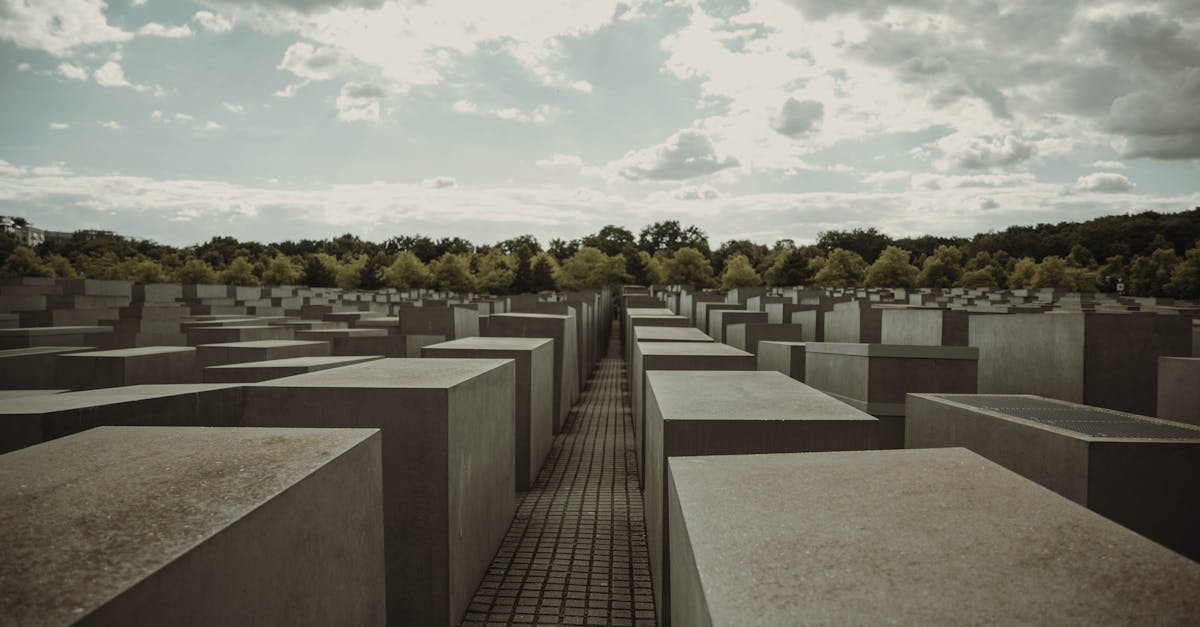
As you step onto the concrete grid of The Field of Stelae, officially known as the Memorial to the Murdered Jews of Europe, you immediately enter a landscape designed to evoke disorientation and introspection. Comprising 2,711 individual concrete slabs, or stelae, arranged in a precise yet undulating pattern across a sloping field, the memorial offers no grand architecture or overt symbolism, forcing visitors to confront the sheer scale of loss through their own physical experience. Walking between these towering blocks, which range from ground level to over four meters high, creates a sense of isolation and claustrophobia that mirrors the terrifying uncertainty faced by millions during the Holocaust, while the subtle shift in elevation under your feet ensures that no single view remains constant, reminding us that history is not static but a complex terrain we must navigate with care.
Beneath this vast outdoor field lies an underground Information Centre, a space that provides essential historical context and personal narratives to complement the abstract power of the monument above. Here, visitors can explore detailed timelines, maps, and testimonies that bring the statistics of genocide back to the human level, honoring the specific lives lost without diminishing the magnitude of the tragedy. For many tourists, combining the emotional resonance of walking through the silent field with the educational depth of the underground exhibition creates a profound encounter with Germany's past, serving as a crucial reminder of the dangers of indifference and the enduring importance of remembrance in today's society.
 This photo was taken by Lio Voo on Pexels.
Underground Documentation: The Topography of Terror and the Documentation Center
Nestled on the very site where the Gestapo and SS headquarters once stood, the Topography of Terror offers a stark and haunting glimpse into the machinery of Nazi terror. Today, this open-air documentation center features an imposing wall of documents that chronicles the systematic persecution leading up to the Holocaust, allowing visitors to walk through the excavated foundations of the former prison cells while reading detailed historical accounts. The sheer scale of the evidence presented here, from arrest warrants to photographs of victims, transforms the abstract horror of history into a tangible reality, forcing a deep confrontation with the bureaucratic evil that operated just steps away from Berlin's bustling Mitte district.
Adjacent to these ruins stands the modern Documentation Center, a striking architectural structure designed to guide you through a comprehensive narrative of the regime's crimes without ever losing sight of its human cost. Inside, multimedia exhibits and archival materials provide a meticulous timeline of events, connecting the local atrocities in Berlin to the broader context of the genocide across Europe. For any traveler seeking to truly understand the weight of Germany's past, this dual experience of standing amidst the physical remnants of power and engaging with the profound stories within the museum serves as an essential, reflective journey that bridges the gap between memory and education.
 This photo was taken by GeVe #Photo on Pexels.
Remembering the Victims: Key Sites Along the Memorial Trail
As you walk the Memorial Trail, known locally as the "Gedenkstättenweg," you will encounter a series of poignant sites that serve as silent witnesses to one of history's darkest chapters. Beginning at the site of the former Gestapo headquarters on Prinz-Albrecht-Straße, now occupied by the Topography of Terror documentation center, visitors can explore the ruins of the SS and police leadership buildings while viewing extensive exhibits detailing the machinery of persecution. This journey continues to the Berlin Wall Memorial in Bernauer Straße, where the tragic division of the city is inextricably linked to the broader narrative of totalitarian oppression, offering a somber reminder of how political ideologies shattered families and communities.
Further along this path lies the crucial yet often overlooked memorial at the former Jewish orphanage on Levetzowstraße, which was used as a transit camp before deportations to Auschwitz, standing as a stark testament to the systematic erasure of Jewish life in Berlin. Each stop on this trail is marked by subtle but powerful plaques and architectural interventions designed not to glorify, but to provoke reflection and remembrance. By connecting these dispersed locations, the Memorial Trail allows tourists to piece together the fragmented geography of terror, ensuring that the stories of the victims are not lost to time but are instead honored through active engagement with the places where their lives were cut short.
 This photo was taken by RDNE Stock project on Pexels.